

SAP Solution Manager support ends in 2027, but Cloud ALM doesn’t cover everything. Here’s what companies need to consider now to ensure a smooth transition.
SAP will end regular maintenance for Solution Manager at the end of 2027. For many IT organizations, this sounds like a simple tool swap: out with the old, in with SAP Cloud ALM. However, a look at SAP's own documentation shows it is not quite that simple. While Cloud ALM is the future platform recommended by SAP, it simply does not cover key Solution Manager functions, most notably IT Service Management and Change Request Management (ChaRM). Anyone who overlooks this will find themselves without a functioning ITSM system in 2027.
Regular mainstream maintenance for SAP Solution Manager 7.2 ends on December 31, 2027. After that, maintenance can only be extended to a limited degree: Extended Maintenance runs until the end of 2030 and no longer covers the full range of functions. Those who wish to continue beyond 2030 will end up in "Customer-Specific Maintenance"—without further development and without any legal entitlement to new notes or fixes.
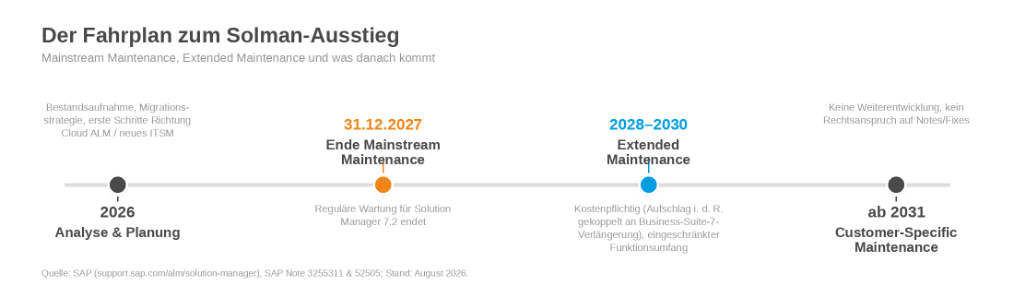
Today, in October 2026, there are about 14 months left until the hard deadline. That is very little time for stocktaking, tool selection, migration, and building expertise in a new system landscape.
SAP openly admits this: In the official "Modularization of ALM" table, IT Service Management is simply listed as "not in scope," with the note that this function must be covered by a third-party provider. For Change Request Management, Cloud ALM only offers "Change Enablement," a functionally much leaner alternative that lacks the familiar depth of ChaRM. Other functions such as SAP EarlyWatch Alert, Business Intelligence Monitoring, Data Volume Management, and Data Consistency Management are, according to SAP, either "not in scope" or "not planned."
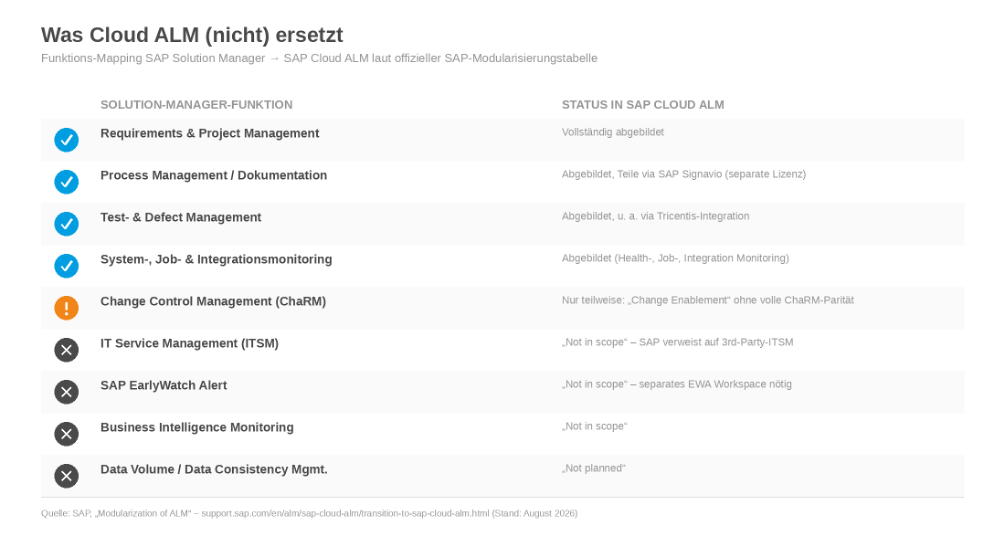
The reason for this is strategically understandable: Cloud ALM is intentionally designed to be leaner and cloud-native, whereas Solution Manager has evolved over two decades into a Swiss Army knife for mature, hybrid SAP landscapes. It is precisely this gap—especially in ITSM and ChaRM—that companies must actively close before Solution Manager is switched off.
An often underestimated aspect is that for many companies, Solution Manager was the only direct connection to the SAP Support Backbone. If this connection expires without a replacement, IT departments lose the direct link between their own (often non-SAP) ITSM tool and the SAP world—with consequences for incident, change, and service request processes along the entire service supply chain.
The 2026 DSAG Investment Report, a survey of 198 SAP user companies from Germany, Austria, and Switzerland, shows that while awareness of the issue exists, concrete action is still lacking in many places. Only 24 percent of respondents are already using the SAP Integrated Toolchain (which includes Cloud ALM alongside Signavio, LeanIX, and WalkMe) either partially or fully. 39 percent are planning to do so at least in part, 17 percent have no plans for usage, and 16 percent are either unaware of the toolchain or do not consider it relevant.
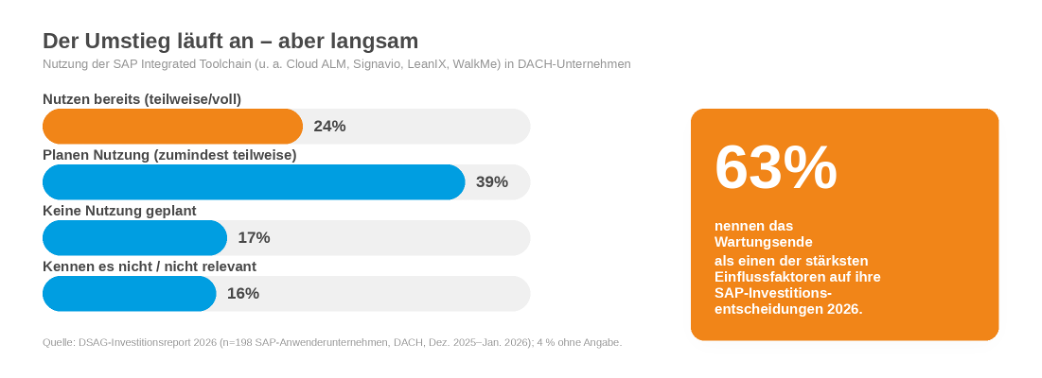
It is also telling that 63 percent of respondents explicitly cite the end of maintenance as one of the strongest factors influencing their 2026 SAP investment decisions—even ahead of the implementation of legal requirements. The topic has long since reached the awareness of IT decision-makers. However, concrete implementation often lags behind, frequently for the same reasons that delay the S/4HANA transformation: a shortage of skilled workers, parallel projects, and limited budgets.
Technically migrating from one tool to another is only half the battle. The real challenge lies in process continuity: ongoing change requests and change documents, open incidents, service requests, problems, knowledge articles, and their archiving must not be lost during the transition—if only for regulatory reasons. At the same time, process discrepancies between the old and new tools must be cleanly addressed while support staff are still learning the new setup.
A "big bang" switch on a single deadline is rarely practical given this level of complexity—the risk of process disruption and data loss is simply too high.
Based on our project experience and discussions with experts, an approach we call "elastic migration" has proven effective: running the old and new ITSM tools in parallel with demand-based synchronization, rather than a hard cutover date.
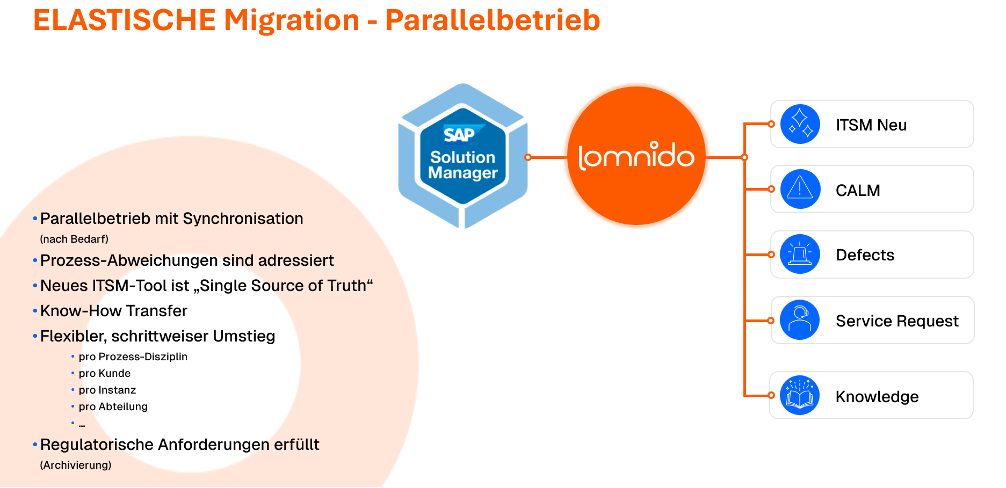
Core of the approach:
· The new ITSM tool is positioned as the "single source of truth" from the start, while the Solution Manager is allowed to phase out in a controlled manner.
· The transition is flexible and gradual—by process discipline, customer, instance, or department, rather than for the entire organization all at once.
· Process discrepancies between the two systems are actively addressed during the transition phase rather than ignored.
· Know-how is transferred in a targeted manner so that support teams understand the new processes before the old environment is switched off.
· Regulatory requirements, particularly the archiving of historical knowledge and change data, are factored into the planning from the beginning.
This keeps day-to-day operations—incidents, service requests, changes, defects, knowledge—stable throughout the entire transition period, while migration takes place in the background in a controlled manner.
SAP Cloud ALM is a useful component for monitoring, project management, and test management—but it is not a full replacement for the Solution Manager as long as core ITSM and ChaRM functions are missing. Anyone who wants to avoid reaching the 2027 maintenance deadline at the very last minute should start taking stock now and plan a solution for the resulting ITSM gap.
This is exactly where Lomnido comes in: With our LomnidoCollaboration platform, we seamlessly connect your new ITSM tool with the SAP world and all other partners in your service supply chain – ensuring full traceability, early detection of process gaps, and a transition that won't disrupt your day-to-day operations. Get in touch with us if you are ready to tackle your Solution Manager migration now.